HISTORY OF THE SANTA FE RAILYARD
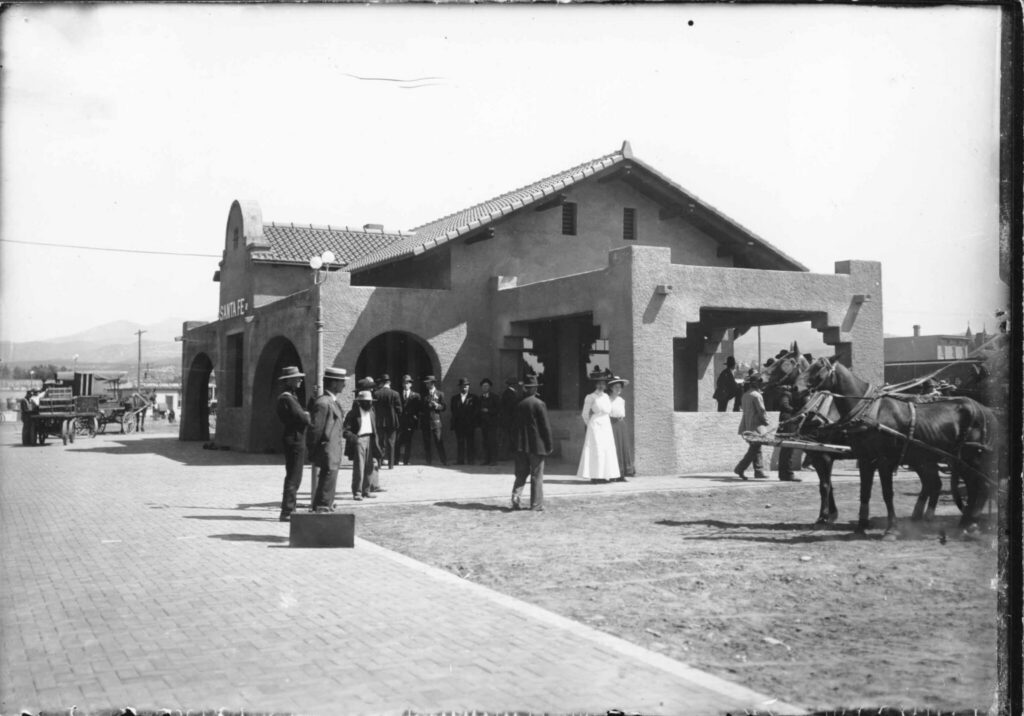
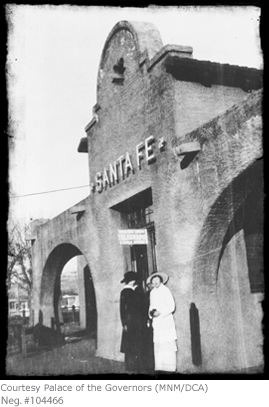
On February 9, 1880, the Atchison, Topeka and Santa Fe Railway Company ushered its inaugural train into the Santa Fe, New Mexico station, marking the event with speeches and a parade. To put this event in historical perspective, at that time Rutherford B. Hayes occupied the White House.
This train’s arrival marked the end of perilous travels via horseback, covered wagons, or stagecoaches along the rugged Santa Fe Trail, initiating an era of economic and societal transformation that continues to shape Santa Fe’s present-day life.
The introduction of the railroad led to an influx of tourists and new settlers via its sleeper and dining coaches, accompanied by the Harvey Girls en route to the Harvey House-La Fonda Hotel on the Plaza. Illustrators and photographers employed by the railway produced captivating images of Santa Fe, aiming to attract visitors from the distant East to explore the Western region.
Indigenous Native American and Hispanic handiworks were crafted specifically for sale to those journeying by train. With the new railway in place, galvanized tin and bricks arrived and contributed to the emergence of metal roofing and Victorian-style brick structures, complementing the traditional pueblo architecture of Santa Fe.
As new communities sprang up to accommodate the laborers and their families engaged in the burgeoning railroad industry, the Railyard in Santa Fe evolved into a hub of bustling activity. The Railyard depot served as a welcoming spot for distinguished visitors, politicians, and stars.
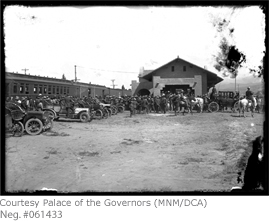
In addition to the narrow-gauge Chili Line that carried produce, two standard-gauge railway tracks entered the city. As a rail terminus, the Railyard utilized a turntable for rotating its locomotives. By the 1940s, The Railyard had become a focal point of activity for residents of Santa Fe. Those who have lived near the Railyard for many years recall spending afternoons harvesting wild lettuce and swimming in the acequia running through the area.
In winter, there was ice skating, and circus visits brought elephants to the town. During the Depression era, local people would gather at the Railyard to receive free meat distributed from the storage facilities. This location continued to be a vital center of activity until after World War II when rail travel started to decline in favor of the burgeoning interstate highway network and air travel.
The Santa Fe Railyard Today
As with many areas across the U.S., the station, tracks, machinery, and adjacent neighborhood in Santa Fe started to deteriorate. By 1987, it was recognized as an area in need of improvement, prompting the start of a comprehensive city plan that same year.
This process of urban redevelopment spanned several years. The city emphasized from the outset the importance of safeguarding the neighboring communities while ensuring that the new development mirrored the original, industrial character of the former railyard. Additionally, it aimed to promote opportunities for local businesses. The community actively participated in the design process.
In February 2002, exactly 122 years after the arrival of the first train in The City Different, the Railyard Master Plan received approval. Additionally, the Santa Fe Railyard Community Corporation was granted a lease and management contract by the city to supervise the development of the 50-acre area. The initial phase of development started with archaeological investigations in 2004, followed by the commencement of infrastructure construction and the preparation of building sites in 2006.
The grand opening in September 2008 marked not just an event, but the revitalization of one of Santa Fe’s historic sites. More than a century later, the City of Santa Fe owns the Railyard land, which now hosts a dynamic array of businesses catering to the varied interests of the community. This includes the Farmers Market, the arts organization — SITE Santa Fe — and the Hispanic cultural hub El Museo Cultural, along with a diverse range of eateries, performance venues, shops, contemporary art galleries, and the state-of-the-art Violet Crown Cinema with its 11 screens.
The New Mexico Railrunner Express commuter service has brought regular train arrivals and departures back to the historic Santa Fe Depot. The year 2017 witnessed the introduction of Railyard Flats, a 58-unit urban residential project, and the impressive expansion of SITE Santa Fe by the internationally acclaimed SHOP Architects. Since its reopening in September 2008, The Railyard has re-emerged as not only a central spot for local life in Santa Fe but also as a novel destination for visitors worldwide.
Click here to view an 11-minute video on the public process and the rationale for the design paradigm.
Recent Developments
1980s The 1980s were a boom-time for growth in Santa Fe; the period also became a time of great planning. In ten years, Santa Fe developed the citywide General Plan, the Business Capitol District Plan and several other plans that would impact the Railyard area.
1985 Mayor Montaño announced a plan to develop the Railyard.
1987 Trust for Public Land (TPL) approached Mayor Pick to encourage acquisition of the Railyard.
1987/June The City of Santa Fe passed a resolution declaring the Railyard a “blighted area,” which required the city to follow state laws while redeveloping the property.
1987-88 The City began planning the Railyard. The Metropolitan Redevelopment Commission (MRC) was created, began hearings and hired Robert Charles Lesser Co. to develop a Master Plan for the Railyard. The City did not commit to a purchase of the Railyard.
1989-90 Atchison, Topeka and Santa Fe Railway Company formed Catellus Development Corporation to prepare development plans for the Railyard.
1991 The Catellus Plan for the Railyard was released. The plan called for the demolition of all the rails and most existing buildings, the development of new buildings up to 6 stories tall, and a total of 1.2 million square feet of development.
1992 The Catellus Plan was rejected by the MRC and the City Council.
1992-93 A neighborhood coalition held hearings to discuss the neighborhood’s desires for the Railyard.
1994 A City of Santa Fe General Plan update reflected a major shift in policies regarding community planning and participation.
1995 The City of Santa Fe purchased the 50 acres of the Railyard with bridge financing support from the Trust for Public Land.
1996/December The City issued an open invitation to Santa Fe citizens to vote on what they wished to have on the Railyard. The number one desire was to keep the railroad running to the historic depot. The public also requested a large park, local business opportunities, and an arts and cultural district within the Railyard. They valued protection of adjacent neighborhoods and keeping the “rugged, gritty” look of the Railyard.
1997/February The City organized a four-week long design process. In week one, over 200 people worked with local architects and planners to design preliminary land use concepts for the Railyard. During week two, the Regional/Urban Design Assistance Team (RUDAT) and local designers produced the Community Plan. The Santa Fe Reporter released the plan as a donation and gift, so that everyone in town could receive a copy. Ultimately, over 6,000 Santa Feans provided input on the design.
1997/Spring City Council unanimously approved the Community Plan.
1997/Fall City staff produced the Metropolitan Redevelopment Plan in order to meet State requirements.
1998 The City of Santa Fe staffed a Railyard Center office in order to implement the redevelopment of the Railyard.
2000/January The City and TPL approved a 13 acre Conservation Easement agreement which included a Park, a rail line re-alignment, and a Plaza and Alameda in the Railyard.
2001/March The City of Santa Fe selected Design Workshop Inc. to develop a more detailed Master Plan and Design Guidelines.
2001/June & September Public meetings were held to encourage full community involvement.
2001/August TPL signed an agreement with the City to manage and finance the design and development of the Park, Rail and Plaza-Alameda easements.
2002/February The Railyard Master Plan was approved by the City’s governing body. The Master Plan honored the history and cultural heritage of the site by embracing the “rugged, gritty” look of the Railyard and encouraging the presence of local businesses and non-profits. A focus was placed on arts, cultural and community organizations. The Railyard continues to celebrate these ideals with the presence of such entities as the Santa Fe Farmers Market, SITE Santa Fe, Warehouse 21 and El Museo Cultural.
2002/February The Santa Fe Railyard Community Corporation (SFRCC), a New Mexico non-profit corporation, was formed from a group of citizens with diverse private and public sector expertise, and entered into a lease and management agreement with the City.
2002/July SFRCC took over the responsibility to oversee development of the 37 acres of mixed-use space for museums, galleries, restaurants, retail shops, office space, and live/work residential units for artists and craft persons, and to build much-needed infrastructure to include utilities, streets, sidewalks and landscaping.
2003/April SFRCC Board hires an Executive Director.
2003/Fall SFRCC received commitments from the city, state and and New Mexico Finance Authority to fund the infrastructure construction and project management. A $500,000 grant was also provided by the federal government to be shared 50/50 with the Trust for Public Land.
2003/Fall The engineering firm Bohannan Huston of Albuquerque was contracted to develop the plans for the new Railyard infrastructure.
2004/September Ground breaking occurred on the Railyard to mark the beginning of a number of archaeological studies which culminated 5 years later at a cost of $1.325 million.
2005 The infrastructure design was approved through a public review process
2006 The first phase of infrastructure construction commenced in the 12-acre Baca Street portion of the Railyard. This $4.6 million project was completed in 2007.
2006 Construction of the $14 million City-owned, 400-space, underground parking garage in the North Railyard commenced.
2007 The second phase of the infrastructure construction totaling $7.5 million commenced in the North Railyard.
2007 Trust for Public Land (TPL) commences construction of $13 million for the Park, Plaza and alameda and water harvesting systems.
2008 The infrastructure was completed. The grand opening event in September was attended by 20,000 people celebrating the long-awaited project. The land parcels were 92% leased.
2008-2013 The entire country plunged into a prolonged economic recession. Commercial real estate lending was impossible to obtain and development was severely impacted. Leased land parcels in the Railyard declined from 92% to 72%.
2014 Six land parcels, comprising 9% of the land area in the Baca Railyard, were leased during the recession , resulting in the construction of residential condominiums, an artist studio, an architect’s live/work office, an art storage and handling facility, and a furniture consignment store expansion.
2015 The 780-seat Violet Crown Cinema opens in the North Railyard.
2015 The last portion of the infrastructure in the North Railyard is completed when Alcaldesa Street and Camino de la Familia streets are connected.
2015 The Railyard Conservation Easement is assigned to the Santa Fe Conservation Trust by the Trust for Public Land (TPL), ending TPL’s 20-year participation in the Railyard.
2018 After nearly three years of entitlement work and one year of construction, the Railyard Flats project, a 58-unit rental apartment building in the North Railyard is completed.
2018 The Railyard Project celebrates its 10-year anniversary with a weekend of community events.
2019 Long term Railyard Tenant, Warehouse 21 Teen Center is asked by the City to leave the Railyards and concentrate its efforts on the southside of Santa Fe due to a shift in teen demographics to that part of the City.
2022 SFRCC celebrates its 20 year anniversary with a community event at SITE Santa Fe.